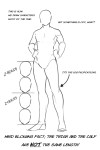
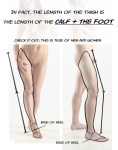
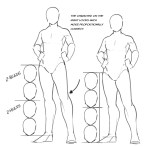
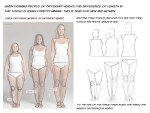
Just a quick thing I put together. This blew my fucking MIND when my anatomy teacher pointed it out. My drawings instantly got better. You might know it (good for you, I wish I knew it before too T_T) or you might not and it might help you get better.
Reblogging a potentially useful tutorial people might be interested in :3
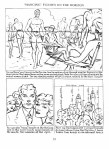
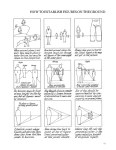
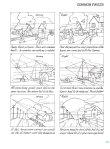
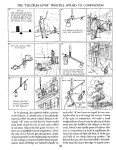
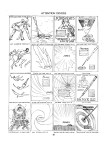
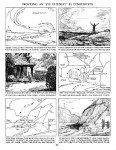
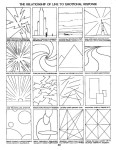
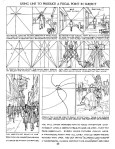
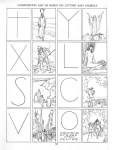
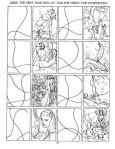
Some sample pages from Andrew Loomis’s series on how to draw comics, 1939-1961, concerning perspective and composition. (The changes in font and layout stem from the fact the pages come from different prints.)
I tried to collect the most useful pages, but of course I’m limited to only 10 images per post.
This is a follow-up of sorts of the Disney “how to draw comics” handouts I posted earlier, and which can be found HERE.
its usually just a lot of experimenting and trying out different solutions before arriving at something, i dont really have a really special way cuz… i also feel insecure about paneling actually ha..ha but!! i really wanna do whatever i can to help so, heres the stuff i usually think about!
in film theory theres a line of filosophy that states that you create more meaning in the relationship between two shots back to back than a single shot. i kind of co-opted that, but for comics! always think about your panels in relation to each other. working super long on one panel to make it snappy, but then neglecting how it looks with the others,
in line with this, never think about just one panel at a time- work on them all simulataneously when storyboarding to see how they flow with each other.
ALSO also related to this- though this is just my opinion- avoid decorating one panel specifically so that it disturbs the reading flow. i have trouble focusing, so this may just be me, and disclaimer for the example i’m about to use- naoko takeuchi is extremely talented and deserves all the success she has, and shes a way better storyboarder than i could ever hope to be. but i mean like this, for example.
the scotch pattern is really cute, but it ruins the reading flow for me totally together w the stark black line between them if you use decorative panels, i’d say use them in a way so that they flow together, or that the decoration goes from panel to panel, connecting them. again, super subjective, but its something i personally think about
always think about how text will look when inserted! dont draw a nice drawing for then to have no space to put text.
try out A LOT of different layouts.
always have coherence first. even if you wanna do something artsy, thats not worth much if no one is gonna understand anything. so study as much as you can about how the mind reads panels and text. this varies from country to country, but its worth noting still no matter what style you end up drawing.
and last just basically read a lot of comics and study what you like/don’t like about them!
alternate panel sizes and shapes!
also, when you sketch up ideas for comics, make them on physical paper if you can, cuz its easier to compare the pages to each other, as well as better gauge how it reads since most people are more used to reading physical comics than on a screen. i have a sketchbook specifically for comic layout sketches, and it looks like this:
that’s.. i think everything i think about so… ehhh i hope it helped and was coherent… .
When you are writing a story and refer to a character by a physical trait, occupation, age, or any other attribute, rather than that character’s name, you are bringing the reader’s attention to that particular attribute. That can be used quite effectively to help your reader to focus on key details with just a few words. However, if the fact that the character is “the blond,” “the magician,” “the older woman,” etc. is not relevant to that moment in the story, this will only distract the reader from the purpose of the scene.
If your only reason for referring to a character this way is to avoid using his or her name or a pronoun too much, don’t do it. You’re fixing a problem that actually isn’t one. Just go ahead and use the name or pronoun again. It’ll be good.
Someone finally spelled out the REASON for using epithets, and the reasons NOT to.
In addition to that:
If the character you are referring to in such a way is THE VIEWPOINT CHARACTER, likewise, don’t do it. I.e. if you’re writing in third person but the narration is through their eyes, or what is also called “third person deep POV”. If the narration is filtered through the character’s perception, then a very external, impersonal description will be jarring. It’s the same, and just as bad, as writing “My bright blue eyes returned his gaze” in first person.
Furthermore,
if the story is actually told through the eyes of one particular viewpoint character even though it’s in the third person, and in their voice, as is very often the case, then you shouldn’t refer to the characters in ways that character wouldn’t.
In other words, if the third-person narrator is Harry Potter, when Dumbledore appears, it says “Dumbledore appears”, not “Albus appears”. Bucky Barnes would think of Steve Rogers as “Steve”, where another character might think of him as “Cap”. Chekov might think of Kirk as “the captain”, but Bones thinks of him as “Jim”.
Now, there are real situations where you, I, or anybody might think of another person as “the other man”, “the taller man”, or “the doctor”: usually when you don’t know their names, like when there are two tap-dancers and a ballerina in a routine and one of the men lifts the ballerina and then she reaches out and grabs the other man’s hand; or when there was a group of people talking at the hospital and they all worked there, but the doctor was the one who told them what to do. These are all perfectly natural and normal. Similarly, sometimes I think of my GP as “the doctor” even though I know her name, or one of my coworkers as “the taller man” even though I know his. But I definitely never think of my long-term life partner as “the green-eyed woman” or one of my best friends as “the taller person” or anything like that. It’s not a sensible adjective for your brain to choose in that situation – it’s too impersonal for someone you’re so intimately acquainted with. Also, even if someone was having a one night stand or a drunken hookup with a stranger, they probably wouldn’t think of that person as “the other man”: you only think of ‘other’ when you’re distinguishing two things and you don’t have to go to any special effort to distinguish your partner from yourself to yourself.
This is something that I pretty consistently have to advise for those I beta edit for. (It doesn’t help that I relied on epithets a lot in the earlier sections of my main fic because I was getting into the swing of things.) I am reblogging this so fanfic writers can use this as a reference.
A good rule of thumb: a character’s familiarity with another character decreases the need for an epithet (and most times you really don’t need one at all).
I don’t mean to impose a personal favour on you guys, but I really would like to ask that everyonewho follows me reblog this.
I don’t think I made it very clear but last month I was sexually assaulted by someone who I thought was my friend (I don’t want to talk about it don’t ask), and it’s… really fucked with my head.
Had I known this a month ago I would have been able to get away.
So, essentially, I’m really pleading with you to reblog this so everyone who follows you doesn’t get stuck in the same position I was with no way out.
I mean again I don’t want the point of this to be my sob story or whatever but if you could reblog this it would seriously mean a lot
and im asking to all of my followers who see this post in your dashboard to please press play to this video, you never know when this is gonna be useful, PLEASE DON’T IGNORE IT.
wait….are any americans aware that the cia overthrew the democratically-elected premier of iran in 1953 because he wouldn’t concede to western oil demands….and how that coup was the reason for the shah’s return to power, the iranian revolution, and the resulting fundamentalist dictatorship…..like, america literally dissolved iranian democracy and no one knows about it???
No. No we don’t know about it.
Americans aren’t told this shit.
The only thing we’re taught about any Middle Eastern country in school is that 1) the region exists 2) it’s where The War is happening and 3) Muslim people live there. That’s it. Maybe if you’re lucky you’ll get into the Hammurabi Code and some early Babylonian stuff but American schools seem to think that if it happened outside Europe and before the colonial period, or makes America look bad and isn’t about A Very Watered Down Version of What Slavery Was, it’s not important.
Info on this is almost notoriously hard to find. It’s not in any texts on American and Russian involvement in the Middle East during the Cold War that I can find. You have to specifically look for a book about the Shah’s return to power, and even then you’d be hard pressed to find a book like that at your local bookstore. Once you get into some higher level college courses you might know about it, but the people who can afford those are more likely to already be indoctrinated into a certain Way of Thinking (read: they’re racist as shit) by the time they get there. And it’s almost like you have to know about it beforehand if you want to find information on it.
The only reason I knew about it is because there’s a thirty second summary of the event in Persepolis. Those thirty seconds flipped my entire worldview.
“All the Shah’s Men” by Stephen Kinzer is a good, accessible text for people who want to know more about this.
!!!
I had to explain literally this to one of my co-workers, who is so fuckin racist against Middle Eastern people it’s insane.
She’s 60. She never heard of this.
As I was explaining this and how, during the Regan years, we funded Osama Bin Laden to fight against Russia, leading to the destruction of much of the infrastructure in the region, one of the plant workers came in to get his badge fixed.
He works in the quality control lab. He served 15 years active duty in the Army. Super smart guy, has a masters in chemistry and another masters in biology, raises saltwater fish in his spare time for sale, has the saltwater aquarium setup of the gods. Raises rare corals too, some of which he donates to be used in re-seeding reefs around the world, but that’s a side tangent.
And he listened for a minute, then nodded and said “Yeah. I was there during that. I helped train people to fight. They wanted us to help them build schools and hospitals, after, but we were only interested in them as cannon fodder. Left the whole area in ruins. I wasn’t surprised when they hated us for it later. Told people then it would happen. We let them know then that they were only valuable to America as expendable bodies. Why wouldn’t they resent us for that?”
And she just looked floored.
“So…” She started, after a few minutes. “What do you think of Trump?”
“I hate him. He’s a coward and he’s going to get good people killed.” He didn’t even blink. “
She looked back and forth between us for a second, and then asked how I knew all this.
“I research things.” I said. “Google is great.” He nodded enthusiastically.
And she just sat there for a second and then said, really quietly, “I didn’t know.”
She lived through it.
American schools don’t teach you any of this sort of thing.
I thought of Persepolis by Marjane Satrapi too. Never underestimate the power of a good book.
Every year in my entire schooling in small town Indiana, we’d start the year studying the revolutionary war. By the end of the year we would reach world war 2. The next year, the cycle would repeat. Every year. Revolutionary war to world war 2. Rinse and repeat.
We never studied the Vietnam War. Korea. No current events. No ancient cultures. No history of other countries. When 9-11 happened I was in high school, and me and my classmates legitimately had no idea who would attack the U.S. or why. We were baffled. Because we were taught our entire lives that America is always the good guy.
History class in America is an utter joke.
it’s very important that people in america know that the reason the taliban exists is because of america. We funded and trained the mujahideen (featuring osama bin laden) to fight back against the soviet union. and we didn’t just throw them a few dollars and some guns, the combined financial investment of the US and saudi arabia was 40 billion dollars. Osama himself said that he never came up with the idea to fly planes into the twin towers, he was inspired to do it as a result of the US backed Israeli invasion of lebanon and the siege of beirut which predominantly featured the destruction of over 500 buildings (and the starvation and bombing of innocent civilians) and directly influenced the decision to destroy american buildings. the US has a long history of destabilizing and overthrowing governments and then just bailing, throwing countries into chaos, and then decades later when the results of those actions come to fruition the government is like “i have no idea why this country hates us, we’ve never been anything but nice to them, and also we help out so many people, and we’re the freest country in the world (◡ ‿ ◡ ✿)”
do yourself a favor and dig into the history of the middle east and central/south asia (afghanistan and pakistan aren’t in the middle east, just fyi, and they also don’t speak arabic), US imperialism, banana republics, and the true cost of living in the land of the free and home of the brave (some exclusions apply)
I also second reading Persepolis. For those who don’t know, it’s a graphic memoir by Marjane Satrapi about her living through as a child – young adult the Islamic Revolution in Iran, with family members who were communisit and socialist, and it goes into how America greatly influenced the chaos of that time.
For a great civilian perspective of the Bosnian War in the 1990s, I highly recommend Zlata’s Diary by Zlata Filipovic.
American imperialism has destroyed so many lives, and in America we are indoctrinated with propaganda to believe that we free, good, and brave, when in fact it’s the opposite.
Read, educate yourselves and others, because the American school system won’t.
@hiranyaksha I feel like some people in your ask box should read this for starters…
please remember that in a healthy, adult relationship (romantic or not), you should be able to talk about things that are bothering you. if you are bottling up your emotions and holding it against someone when you haven’t told them what is wrong, you’re not engaging in healthy behaviour. but also, if your friend/significant other makes you feel as though you can’t talk about what bothers you- i.e. has made you feel guilty/gotten extraordinarily angry when things were brought up in the past- they are not engaging in healthy behaviour.
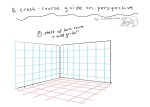
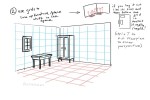
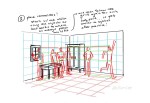
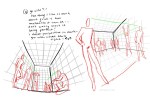
i wasn’t really expecting this to get as much response as it did on twitter but it seemed like people found it helpful so!! here you go! some friends were asking about perspective so i drew up something real simplified on the basics of how i usually set up my perspective/bgs !!



 Archive