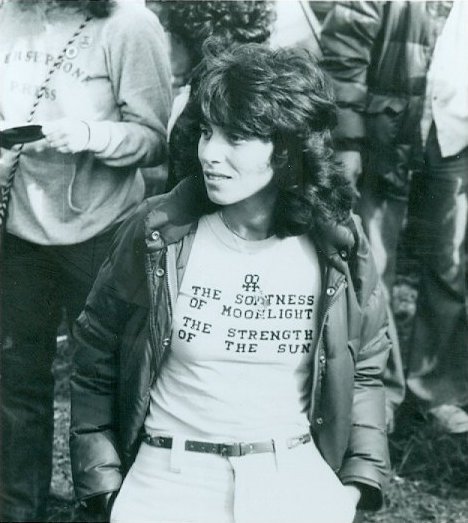
“THE SOFTNESS OF MOONLIGHT, THE STRENGTH OF THE SUN” at the first national march on washington for lesbian and gay rights, photographed by larry butler, october 1979
A story that the Jews tell each other is that when the slaves were fleeing Egypt they came to the edge of the Red Sea and thought: well, fuck, this is it. Water in front of them and enemies behind. They had escaped, sure, but all this meant was that they were going to die free instead of in chains. A meaningful distinction in an abstract sense, but the Jews are a practical people, and mostly what they were concerned with in that moment was: they would be equally dead either way.
A man stepped out from the group. He stepped into the water. He said: mi chamocha ba’eilim adonai? Who is like you Adonai, among the gods who are worshipped? He sang that verse over and over again. He sang it as he waded into the sea. He gave his body over to his faith as he walked. There was nowhere to go but forward. If he was going to die, he figured, and be equally dead either way, he was not going to die in slavery and he was not going to die at the hands of the Egyptians, either. He was going to die walking and singing, believing, trying to find progress in the chaos, in the waves.
In the story, the water laps first at his feet, then his knees, his thighs, his ribs, his neck, finally flowing into his mouth as he sings and sings and sings. The words get choked, mispronounced: the hard cha of mi chamocha becomes mi kamoka, strangled but still certain.
In the story, this man is why the people get their miracle, the waters parting to let them cross through on dry land. It is an act of divine intervention, but it only comes because someone is willing to put his life on the line to make it happen. I keep thinking about him this week, that apocryphal man and how it is a story we make sure to keep telling each other: when there is water in front of you and enemies behind, you do not wait for your god, or a sign. You trust in something larger than yourself and open your mouth to sing about it. You put your feet on the ground and walk forward.
His name was Nahshon ben Aminadav. Descended directly from Judah, he fathered a line of kings. We tell his story to remind ourselves that God does not act in isolation. Humans are not just participants in holy work – we are vital to its success.
the traditional account from the midrash and the talmud actually drives the message in more firmly, with moses praying for nachshon not to drown, and g-d instructing him to instead take action to save nachshon’s life and the lives of all the hebrews. from chabad.org:
When Israel stood facing the Sea of Reeds, and the command was given to move forward, each of the tribes hesitated, saying, “We do not want to be the first to jump into the sea.”
Nachshon saw what was happening—and jumped into the sea.
At that moment Moses was standing and praying. G‑d said to him, “My beloved ones are drowning in the stormy seas, and you are standing and praying?”
Moses replied, “Master of the world, what am I to do?”
Said G‑d, “You lift your staff and spread your hand over the seas, which will split, and Israel will come into the sea upon dry land.”
And so it was. Following Nachshon’s lead, the Israelites entered the sea and were saved.
i’ve never heard a version of this story where nachshon is the one who sang mi chamocha. traditionally, mi chamocha came to be when miriam led the hebrew women in song in celebration after crossing the sea of reeds. interesting to learn about other variations!
Arthur squirms as Alfred shifts closer, breath warm against the side of Arthur’s face as he laughs at a particularly funny scene in the movie. Arthur’s stomach churns. He bites back a smile, cheeks flooding red as Alfred throws his arm around him absentmindedly.
“Popcorn, babe?” Alfred says, mistaking Arthur’s silence for annoyance at Alfred having hogged the bowl.
“Um, n- no, thank you.” Arthur stammers. Alfred beams in reply and turns back to the television.
Arthur sits up straight, hands primly in his lap. He then glances at Alfred. He glances at his knees.
Just do it.
He shifts closer under Alfred’s arm in one fluid, gut-wrenchingly difficult motion, face burning in an embarrassment he hopes to god Alfred doesn’t notice.
Alfred does. He pretends he doesn’t, smiling into his hand as he shovels more popcorn into his mouth.
Not everything is supposed to become something beautiful and long-lasting. Sometimes people come into your life to show you what is right and what is wrong, to show you who you can be, to teach you to love yourself, to make you feel better for a little while, or to just be someone to walk with at night and spill your life to. Not everyone is going to stay forever, and we still have to keep on going and thank them for what they’ve given us.
i. phosphorus; atomic number 15, never found as a free element on earth, essential for life; named for lucifer, light-giver, glows in the presence of oxygen.
ii. girl as a swarm. i keep bees under my tongue, never find purchase, feel dizzy in high places because what if this body jumps. i picture bad moments like blizzards, count and recount what could go wrong and weigh it against the fragile good i sew.
iii. you and blue have a lot in common; the cliche of oceans, the cliche of a river that moves so smooth through my blood i don’t realize until too late i’m terribly drunk, the cliche of a lovely bruise and your voice and the songs you hum
iv.
combustible, relating to combustion; able to catch fire and burn easily.
v. i’ve been learning the names of mythical creatures, i’ve been learning the names of plants and animals, i’ve been learning the names of funny internet kittens. i’m keeping my thoughts organized into “would you like this”, “i have to show you” “how do we hide the truth in this.” my anxiety and i are partners in a landslide hunt; we devour any fact that might convince you we’re good enough.
vi. you as electricity. the blush of your cheeks and how your hair looks when it’s messy. in this is simplicity, i catch, don’t have words for the burning. there’s just you and easy, your body in my sheets, a switch flicking. no noise no static no unbecoming. i know i’m shaky. it’s just the shock of the falling.
vii. melting, to melt: to thaw when exposed to heat. to become more tender, to become more loving.
i. phosphorus; atomic number 15, never found as a free element on earth, essential for life; named for lucifer, light-giver, glows in the presence of oxygen.
ii. girl as a swarm. i keep bees under my tongue, never find purchase, feel dizzy in high places because what if this body jumps. i picture bad moments like blizzards, count and recount what could go wrong and weigh it against the fragile good i sew.
iii. you and blue have a lot in common; the cliche of oceans, the cliche of a river that moves so smooth through my blood i don’t realize until too late i’m terribly drunk, the cliche of a lovely bruise and your voice and the songs you hum
iv.
combustible, relating to combustion; able to catch fire and burn easily.
v. i’ve been learning the names of mythical creatures, i’ve been learning the names of plants and animals, i’ve been learning the names of funny internet kittens. i’m keeping my thoughts organized into “would you like this”, “i have to show you” “how do we hide the truth in this.” my anxiety and i are partners in a landslide hunt; we devour any fact that might convince you we’re good enough.
vi. you as electricity. the blush of your cheeks and how your hair looks when it’s messy. in this is simplicity, i catch, don’t have words for the burning. there’s just you and easy, your body in my sheets, a switch flicking. no noise no static no unbecoming. i know i’m shaky. it’s just the shock of the falling.
vii. melting, to melt: to thaw when exposed to heat. to become more tender, to become more loving.
“What if we read the story of Adam and Eve with different eyes? What if we stop reading it through the lens of popular assumption and allow it to speak in a different way? What if it isn’t an account of punishment for one monumental mistake, but a fable-like wisdom story about humans graduating, evolving from the relatively uncomplicated existence of animal innocence to the messy experience of moral responsibility? What if Adam and Eve didn’t fall? What if they were pushed? What if the voice of God in the story is a poignant warning about what lies ahead for a more highly evolved species than a straight-faced prohibition? What, in short, if we read the story with irony instead of literalism, with a grin rather a grimace, as wisdom instead of dogma?Hard work, sexual intimacy, parenthood, a sense of mortality, the knowledge of good and evil – these are the sort of things that make humans different to other creatures in a positive way. They present challenges and demands, and bring anxieties, but they are also the ultimate source of imagination, creativity, rewarding struggle and achievement. In order for humans to be human, the fruit had to be eaten…Thus the story of Eden is not about paradise lost, but about paradise outgrown.”
— Dave Tomlinson, The Bad Christian’s Manifesto: Reinventing God


 Archive