This is probably the best ukulele playing I’ve ever seen.
It’s always wild when people are amazed by proper Ukulele playing because what they consider “good” is whatever mainlanders are attempting to play while asserting some “quirky” vibe. Ukulele has become trendy on the mainland and people are amazed by what we consider BASIC skills and boring same chord repetition over and over. PLUS malihini don’t even pronounce the name right (what the fuck is a yuu-kuu-lay-lee hahaha).
Here in Hawaiʻi we are busting it out (like these killer wahines) every day in ways you can’t even imagine. Half my nā hoahānau play like this!
We stay laughing. These wahines choke deadly.
This must be what surf rock guitarists were trying to emulate in the 60’s. It’s so fucking good.
You have to learn how to say no without you feeling like you’re being mean. Setting boundaries is how you see who does and doesn’t respect you, your time, or your emotional well-being. Anyone who sees your boundaries and thinks your being mean or tries to push that boundaries is not a person you owe your time or attention.
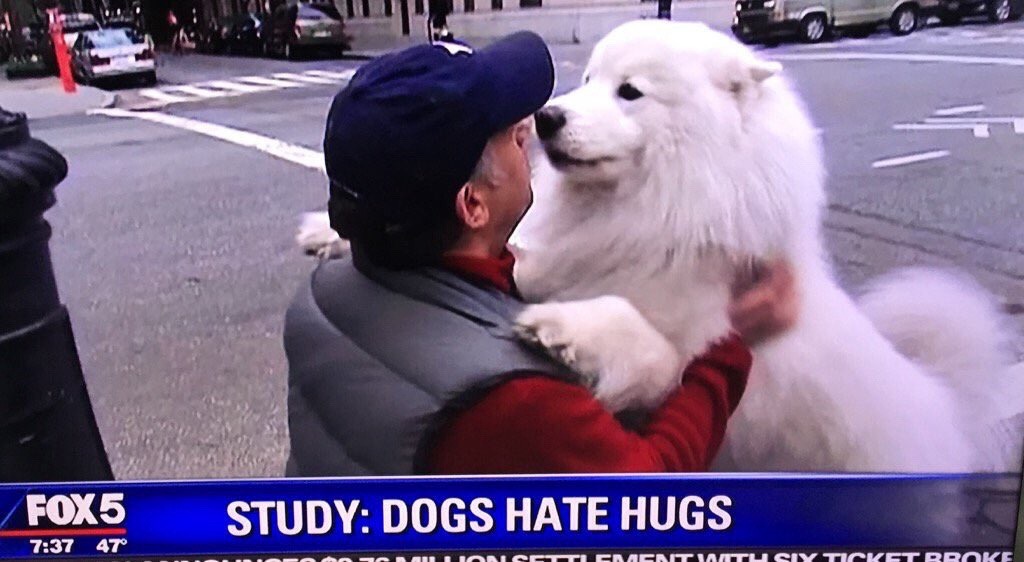
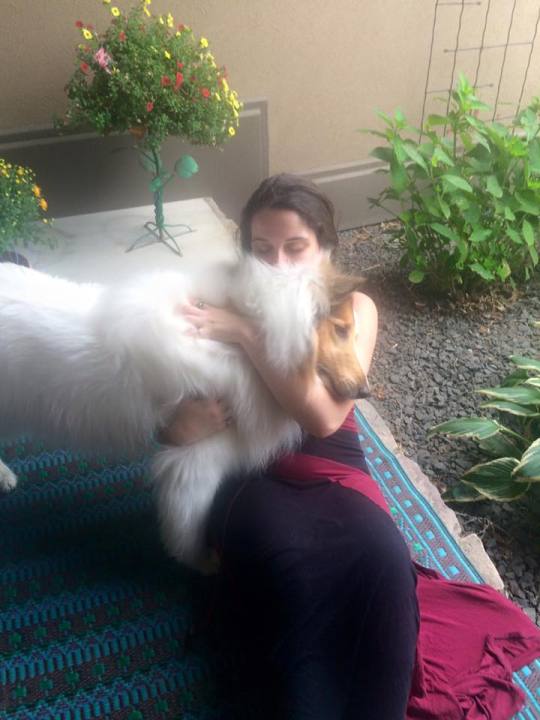
As a dog trainer, I can tell you that probably 50% of dogs really don’t like hugs and at least another 48% pretty much just tolerate them. Very few dogs I know genuinely like hugs the way humans tend to give them. What’s funny is that the picture that Fox used with this headline is one of the more common ways dogs do enjoy contact that humans would consider a hug.
Stanley Coren – the dude who wrote the article that is pissing everyone off about this – really does know what he’s talking about. He wrote one o my favorite books, called how to speak dog, which has some absolutely beautiful diagrams of dog behavior and body language along the gamut of extreme situations.
The way humans hug dogs is often really uncomfortable for them. We lean over them and trap them (think how many dogs we already know are spooky when you loom over them, but are fine if you get down to their level), and then we restrict their ability to move and shove our faces close to theirs. That’s not fun. Keep in mind that most dogs have personal space bubbles that are larger than we tend to think, and now you’re not only invading it, you’re making it so they can’t move or defend themselves if something happens.
Look at this photo from a couple years ago. Avalanche is probably the most tolerant dog I know of things that press his physical boundaries – he lets little kids do things to him that make me cringe and doesn’t even seem to notice half the time. This was right before I had to head back to college and I knew I wouldn’t see him for another 6 months, so I hugged him because sappy human emotions. I have an amazing relationship with this dog, and look at his body language. He’s kinda stiff, his face is a little tense, and the corners of his mouth are pulled back a little. All in all, he’s supremely un-enthused but he’s letting me do it. After about five seconds, he huffed out the sigh he uses to let me know when he’s done with the hug, and then pulled back and shook off.
Most dogs learn to tolerate hugs because we do it to them so often. It’s pretty much a kind of learned helplessness, plus, they like us and so they put up with our stupid human behavior. When you hug most dogs, you’ll notice they get kinda stiff, they look away or at other humans for help, you’ll see side-eyes or look-aways (not whale eye). Often they’ll distract you by doing something else like pawing at you, or licking your face as an appeasement signal. They’re all signs of discomfort that we already routinely ignore when we deal with our dogs, so it makes sense that people think their dogs are fine with it – they’re just still not listening.
More often, you’ll get dogs that will crawl up your chest when you sit and put their paws on your shoulders. Sometimes their face is close to yours, sometimes it’s on your shoulder. In that position – which they often initiate – they ca easily withdraw and get away if necessary and they’re not trapped or being leaned over. It’s not really a hug, just close contact, but I think it’s about as close as humans are going to get to one that a dog will enjoy.
This is why it’s so important not to anthropomorphize your pets and actually take the time to learn THEIR body language and natural behaviors.
And if y’all take the time to learn this, you’ll find most dogs have their own ways of showing affection that are equivalent to hugs. My dog doesn’t like to be held tight but she does come up beside you and press her head against your body and lean against you and that’s basically her version of a hug. She’s nervous and doesn’t like to be forced into any interaction but she will sometimes come and snuggle her head in my lap just because she wants to. And if you force interactions and hugs and cuddling with your pet, you’ll miss out on those particular shows of affection that they offer on their own which are way way more special than a forced hug.
gabi: in russia, the act of displaying the LGBT flag in public can get you
arrested. so these 6 activists from latin america resorted to
creativity: wearing uniforms from their countries’ football teams, they
turned themselves into the flag and walked around moscow with pride.
I’m so sorry you’re being surrounded with pedophilia apologism. I can absolutely explain my thoughts on this.
Pedophilia is a paraphilia, not an orientation.
An orientation describes the gender of those to which one is capable of being attracted. It does not mean that someone is attracted to the idea of a gender, or that they are going to be attracted to anyone of that gender, and orientation does not inherently include sexual attraction (for instance, you can be attracted to someone without being at all interested in sexual intimacy, people of all orientations can have crushes as little kids in purely romantic ways, people of all orientations can be asexual and never be sexually interested in anyone, etc.)
To the contrary, a paraphilia refers to recurrent, intense sexually arousing fantasies, sexual urges, or behaviors. Paraphilia might include fixation a variety of qualities or concepts, but often involve dehumanization/fetishization (e.g. “teratophilia” sexual desire to people with severe deformities, often based in a dehumanizing perception of them as “monstrous”), as well as nonconsensual or violent behavior (e.g. “zoosadism” being sexually aroused by inflicting pain on animals, or “frotteurism” being sexually aroused by non-consensually rubbing their genitals against strangers).
This distinction is extremely important. Sometimes homophobic pedophilia apologists will bring up that “homosexuality” used to be included in the DSM as a paraphilia and present that fact as a way to either demonize gay people or to defend pedophiles. I want to be extremely clear in that the previous decision to call people’s same gender attraction a paraphilia was a reflection of deeply homophobic views about LGB+ people.
They did so because they reduced our entire personalities into the desire for specific sex acts, and also often depicted us as predatory and seeking out non consenting straight people. If wildly homophobic beliefs were accurate, yeah, that would be a paraphilia, but it’s fucking wildly homophobic and completely inaccurate.
They used that diagnosis to completely demonize us, and to justify various forms of abuse and torture. It was institutionalized homophobia and anyone who uses that as an argument to suggest a bullshit ‘moral relativist’ argument that “anything could be considered a paraphilia, maybe we need to accept everyone, pedophiles are the new gays!!” they are being horrifyingly homophobic and contributing to pedophilia apologism and rape culture and they need to fucking stop.
Pedophilia is a fetishization of abusive control
Pedophilia is intrinsically linked to abuse, and indeed multiple studies have shown correlation between men abusing their spouses and sexually abusing their children.
“Multiple studies have established the high overlap between battering and incest perpetration (Herman, 1981; McCloskey et. al.; Paveza; Sirles and Franke; and Truesdell et. al.). These studies, taken together, indicate that a batterer is about four to six times more likely than a non-batterer to sexually abuse his children. These statistics are in line with studies of batterers’ risk to physically abuse children; the largest study of this kind showed batterers seven times more likely than non-batterers to frequently hit their children (Straus) About half of incest perpetrators also batter the children’s mother (Herman, 1981; Sirles and Franke; Truesdell). A recent major publication on family violence recommended that any history of sexual assaults against the mother be treated as a warning sign of possible sexual or physical abuse of the children (American Psychological Association).”
Pedophiles are not attracted to individuals, they are fetishizing and aroused by their projected ideas surrounding innocence, control, power, possession, corruption of innocence, vulnerability, etc. Pedophilia is inherently abusive (yes even for “non offenders”) because abuse stems from abusive values and entitlements.
There is a quote by Lundy Bancroft which, while not specifically about pedophiles, explains the way that abusers understand love, and I think it’s relevant to include, because pedophiles and their apologists will try to depict this as attraction to people when it’s not, it’s fetishization of abusive control over children.
“Another point I wanted to draw your attention to is how the abuser defines love. Part of why I underline this point is because this is one of the areas where abusers have the most success in creating confusion. When he says ‘I really love you’ that’s all about him not about her. The feeling that he has, through his teens and into adulthood, come to identify as love, is not the same feeling that you and I would call love. This is about a very intense desire to own and control somebody. That’s not very related to seeing this person as a human being. It’s much more akin to how you would become attached to a thing. ‘I love you’ means ‘I am so attracted to what I believe you could do for me.’ […] ‘I am so attracted to what you must do for me. What it is your obligation to do for me.’”
They engage with this paraphilia, not because it is an intrinsic part of them, not because they have no control over their own behavior (they do, it’s a choice they’re deciding to make), and not because they’re unable to confront their extremely harmful values and beliefs, but because they’re unwilling to. The same reasons that abusers continue to abuse their partners, the same reasons serial rapists continue to sexually assault others– pedophiles continue to engage in the fantasy or practice of sexually assaulting and abusing children.
Pedophilia is not a disease to be ‘cured’ it is a set of abusive values and practices that we should treat as unacceptable.
The reason that it’s dangerous to assert that pedophilia is a disease is because this mythology (largely created and perpetuated by pedophiles and abusers themselves) contributes to a pedophilia apologist and CSA apologist culture wherein we are expected to extend sympathy to the perpetrators of this violence, and we are expected to forgive them or grant allowances to “non-offending” members because of the false notion that it isn’t their “fault” or that there is no “cure.”
But it’s important to realize that these desires are prompted by their values and their behaviors are chosen, consciously. We need to hold these people accountable. It is not a disease or an orientation or any other excuse that allows pedophiles to insist it’s “out of their control.”
Extensive research with abusers shows us that the only chance there is to “cure” abusers or, more accurately, to get them to stop abusing people, is to give them literally no choice. Abusers need to be held accountable relentlessly. Their abuse must be consistently be considered unacceptable under any circumstances, and they must face consistent consequence for every single transgression.
Within an abuse culture and rape culture like ours, the odds of pedophiles actually being relentlessly held accountable are not great, there are far too many apologists and people willing to protect them from accountability. So for anyone in danger, we need to prioritize getting them away from these people and protecting children. In my opinion, children’s safety will always always always be the immediate priority.
So anyone who is prioritizing trying to “cure” pedophiles and doing so through essentially buying into pedophiles’ own mythos of their abuse being an “orientation” or “illness” is contributing to a culture that harms children. It is actively dangerous to feed into the belief that pedophiles need compassion and understanding for their abuse. Abusers do not deserve compassion for their deep entitlements and toxic values, they deserve condemnation and being held accountable until they are forced to give up their violence.
i have always had this trouble. my soft heart and good listening meant i was always, always, always somebody’s therapist. i was dealing with so much of my own shit that it seemed unfair not to be there for someone else. i knew exactly what it was like to reach out and be shut down because “they don’t have time”. i knew what it was like to have someone say “just go to a therapist.”
it ruined my life. i want to make this very clear. when i was younger and before i got good at boundary settings, it ruined my life. i was so invested in the internal lives of people i still considered “friends” who were using me for endless emotional labor. it completely disregarded that i was also mentally ill and struggling. i was constantly anxious, rarely sleeping, unable to control the actions of not only the other person – but also of myself. i poured hours a day into trying to talk people down from things i couldn’t talk myself down from. wasn’t trained at all. i was triggering myself by talking about certain things, throwing myself into a deeper hole in the hopes i could maybe drag everyone else out.
a lot of these people don’t even talk to me anymore. they found a new therapist and moved on, because they weren’t my friend. they were using me for my advice and time and endless attention. putting myself into their hearts didn’t push all the bad stuff out. it just made me drown in the bad stuff.
and it’s complicated; because i’ve been on both sides of this. desperately needing to just vent, no threat of the police, no professional setting, just me and someone i trust talking. i would fall into bad patches and my family would have to scrape me up. i would spend months in a bad place. needing to be pushed. to be prodded. so how can i say “don’t use your friends as therapists?”
the truth is, there’s a huge difference between leaning on someone versus expecting them to be there for you all the time when you don’t return any of that effort or emotion. i had a “friend” who waited 5 hours until i was home from a loved one’s funeral, and when i said “i’m home”, she just launched into her own problems. i remember sitting on the kitchen floor and sobbing because she literally didn’t even ask if i was okay. she didn’t ask if i was ready. she didn’t even ask anything, she just assumed that i was always there for her, always, and that she didn’t need to be there for me.
and the truth is: i don’t need much. i actually get uncomfortable when my friends thank me a lot. but the difference between a friend and someone you’re treating like a therapist is that friends let friends have their own moments. and i know that we have all had overlapping emergencies. that you know he’s having a really rough time because of his classes but you were just triggered by something you weren’t expecting. but friends are the people who start with “i know it’s a bad time, i just need to vent, are you okay?” not the people who don’t even acknowledge the bad time. not the people who don’t give me the option to say “no, i’m not okay, if it’s an emergency we can talk but i’m in a really bad place and i can’t stand anything else.” i can’t save you while i am also struggling to save myself. friends are the people who maybe, yes, vent – but then give you the option to also share, to have your voice heard. you know that you’ll get a chance. maybe not that day, but soon, if you wanted it.
there is a huge difference between someone asking about my life, genuinely listening and responding, and then talking about their problems, versus someone who basically says “are you gud?? okay here’s my life trauma for you to deal with.” everyone here has been in a conversation where the other person was literally just waiting for you to shut up so they could hear their own voice. that’s what it’s like as a therapist friend, all the time. your life becomes this inconsequential thing to them. peripheral to the help you can give.
and if you’re the therapist friend, it’s hard. do you have any idea how much responsibility i feel, all the time?! the sad thing is yes, i overextended myself and became majorly suicidal because of some of my friend/patients – but i know that if it helped them, just a little, it was worth it. but my personal safety a- mental and physical – shouldn’t be offered at all in the trade.
real therapists, paid-for-it therapists…. they’re not on every hour of the day. they go home and have a home life where their patient isn’t texting them every 18 seconds about a new emergency. that’s because the human spirit can’t survive that. we can’t survive that. and as the therapist friend, it’s hard. we are givers, you know. feel better when helping.
but learn to set boundaries. i’m so used to the whole therapy thing that i can literally tell when someone is switching from my friend to my patient. i pull out all of my personal information. i put up a bunch of walls. i make their notification different. when i see it’s a message from them, i do a self-check: am i ready for what might be inside? do i have the energy for it? can it wait until i am in a better place? will it ruin my day?
and learn to say no. be honest. if this isn’t a true emergency, learn to say. actually, no, i don’t want to deal with this. it doesn’t have to be for “a good reason”. it can just be …. that you’re not their therapist. you’re their friend. you saying “no” isn’t being selfish.
i know texting has made it easy to forget this. but …. the next time you’re about to vent to a friend, just ask: “i need to talk about something heavy, are you in a good place?” and when you can, give back. remember to talk about their favorite book, or ask about that party they went to. because it’s okay to lean on people. but just give back a little of the energy you took.














 Archive