sun in the 7th: Wants to embody and radiate vibrant love in their relationships. wants someone to make them feel whole. Attracts/attracted to loyalty and fun-loving charisma and confidence, people with big hearts.
moon in the 7th: Wants emotional connection in their relationships. to love and be loved. unconsciously seeks motherly, nurturing figures. Attracts/attracted to psychic connection and a sentimental, tender character.
mercury in the 7th: Wants cerebral completion from their relationships, for their partner’s mind to work at the same frequency. Attracts/attracted to clever, witty, humorous intellectuals, people who provide equal communication.
venus in the 7th: Wants beautiful love that exemplifies equitable relationship, two parts of the scales uniting into one. Attracts/attracted to inviting charm, sophisticated, and pleasant, sweet company.
mars in the 7th: Wants vivid and intensely adrenalized relationships, for someone to light the flame inside them. Attracts/attracted to sparkling, energetic motivation and exciting, sexual types.
Jupiter in the 7th: Wants a lively and spirited relationships, for someone to help them discover their soul’s roadmaps. Attracts/attracted to big-hearted, friendly, philanthropic and knowledgeable individuals.
Saturn in the 7th: Wants a relationship that will bring structural comfort, a partner who will respect them and help them find their wisdom and sense of Order. Unconsciously seeks fatherly, mature, sustaining figures. Attracts/attracted to prestigious, refined, disciplined and reliable individuals.
Uranus in the 7th: Wants a relationship that will defibrillate the heart, for someone to excite and liberate them (or to be liberated from relationship). Attracts/attracted to unusual, eccentric, intelligent and universally understating individuals.
Neptune in the 7th: Wants redemption in a relationship, to save and be saved, an emotionally divine union. Attracts/attracted to sensitive, devoting, imaginative and universally empathatic types.
Pluto in the 7th: Wants a relationship that will empower them, a powerfully psychic and emotionally intertwined connection that will renew the heart. Attracts/attracted to compelling, mysterious, focused and sultry figures.
I’d argue that air and fire moons are more sensitive than water and earth moons any day. It’s just that you have to get them to open up first to see it, which is hard sometimes.
I agree tbh. When any of my air or fire moon friends open up with me, I’m always shocked to see how much they’re feeling underneath their mask. Not to say that water or earth moons aren’t sensitive, they are, it’s just that I think that fire and air moons can easily be written off as cool, careless and unemotional. A lot of these guys feel emotions as well, we just don’t see it as often.
Going along with that, fire/air moons are also misunderstood many times as they have trouble expressing their emotions to communicate how they really feel.
Aries moons are scared of how others will react to their feelings and don’t want them to leave them, so they stay silent to not make any more trouble than they already do. I also think that since they’re always labeled as ‘troublemakers’ or ‘immature’ they think others won’t take their feelings seriously.
Leo moons are fear that their reputation will be tarnished if they associate with sensitive and emotional feelings, they like to feel powerful through their pride.
Sagittarius moons have taken on a role to be so carefree and optimistic they think its their role to always be positive for others, so they push away their emotions to not feel selfish.
Gemini moons think so much that they don’t want to burden anyone with how much they actually think about things because it may take forever and they feel as if they are overreacting.
Libra moons always want to be perfect and ideal, when negative thoughts enter their mind they want to get rid of them and stay confident and strong without realizing how important emotions are, even the negative ones.
Aquarius moons don’t know how to deal with emotions themselves, they don’t want to talk about them because they prefer for everything to be normal, because to them feelings are weird and a foreign concept.
I’m not sure if I was correct through this but this is my intake of the signs and why they don’t express themselves easily. What I do know is they the fire/air signs are just as emotional as the other signs and think about the same things and go through the same conflicts, so don’t dismiss their troubles because it’s unusual. It takes a lot for them to open up and tell someone what they’re feelings, and if you’re that person, you’re special to them. I remember opening up to someone awhile ago and they said I was lying about my feelings because I was always ‘happy’ so I didn’t know what it was really like to be sad, it was pathetic.
Also, as someone with air Moon trine air Rising and fire Midheaven with Pluto conjunct it, when I’m sad, the few people who realise just read me as being angry or pissed off. Like… we can’t share how we feel because it really isn’t understood, and that just makes us hole ourselves in more
hi i have seen a lot of people talk about how they’d describe this but the truth is that (in my opinion) there’s a lot of stylistic choices here that i just want to talk about for a hot second 🙂 just some ways of thinking about it? that might help you get unstuck?
is your book even the kind of book that has long paragraphs of description? if you’re seeing something beautiful, you can just say, “there was a beautiful green and flowering field with a nice lake, a rolling fog, and mountains beyond” and let people make their own assumptions about what it looks like and movetf on.
“no raquel i really like long paragraphs.” okay time to get into The Senses. imagine yourself there. what would the grass feel like underfoot? is it soft, well-watered, or is it crunchy? do the flowers smell like death or do they smell good? is that fog or the gunsmoke from beyond the frame? are the mountains something to be passed over or surveyed? walk through all the senses. i really like adding smell because it’s the one most tangibly connected to memory (look it up). if i say “the field was green and smelled of wildflowers” that’s something connected to your senses. if i say “the lake, although still, reeked of blood” this is a whole different type of story. senses matter!
on that note, think about the poetry of it. are you the person who just says “clouds” or “rolling fog”? it’s okay if you’re either! i often switch between the two, because i don’t like long descriptions in my pieces and i don’t know why. and the tone of your piece should define that. if this is looking back on a fond memory, it should maybe be airy, light, full of “gentle, sun-kissed flowers” and “lambs-wool grass.” metaphors and similes and lots of fun things. but if it’s something like … this is a place we’re spending 12 seconds in during the story, don’t? bother? wasting your time? maybe the tone is being rushed, you’re looking out a train window and only get a glimpse. close your eyes and write what 12 seconds would give you in memory – a morose “it was beautiful out there, green and full of water and fog, mountains on the border” or a weary, “out there, in the fields and clouds and mountains”. see how even a few words changes tone?
sometimes there’s such a thing as trying too hard. plopping a word like “verdant” casually in there? great. when it’s “verdant green and crimson red flowers” etc it gets really tiring to write and read. make either your descriptions interesting with unusual terms – “bloodmoon red” idk – or stop driving yourself wild with more ways to say “beautiful.” say it and move on. this is also where tone is important – “verdant green and soft, whispering red flowers” is different than “violent green, with flowers shining in bloodspills upon it”. tone is …. crucial in expression.
i personally hate long descriptions. if you read half my stories, i straight up won’t describe things, because i don’t want to. here’s what i do instead: character-led discovery. instead of the narrator walking us through it, we discover it w/the characters, making it a little less outside of the story and a little more fluid. “he sat on the verdant grass, his fingers reaching to pick one of the many wildflowers. his head tilted to let the sun on his face, watching the clouds move at the foot of the mountains beyond.” aww so sweet 🙂 for me this is even like. more description than usual? because honestly unless these mountains gonn be important, who cares.
secondarily this is more what i think of when people say “show not tell” because everyone always stops at the senses but you gotta show like… how do your People interact with it. example: i’m colorblind. how i interact w/this gorgeousness is totally different.
but then you can also like ? let your characters literally do it for you:
“It was a field,” she shrugged, “It was like, super green and flowery and shit. I don’t know. there were clouds clouding along and mountainous mountains. what do you want from me. i felt like a deer frolicking in the got damb meadow come to dip my little deer nose into the nice little lake.” she slumped over. “i’m tired,” she added.”
literally let them talk for you. let them have your voice and say what you want the audience to get. “dude come look at this lake. it’s like. got a little halo of grass and flowers shit is so got damb cute” “nah man look at the mountains” “you’re all wrong check the ghost-clouds” “woooahhhh” actually works, and dialogue is a million times more fun to read and write (imho only tho) than like lines and lines of trying to force people to see what you see
on that note, unless it’s crucial people do see what you see? give up. let them figure it out on their own. watch a new scene: “she swore and went back for her shoe, dangling useless in the sewer grate, trying to keep her stocking foot aloft as she navigated the crowded sidewalk.” chances are, many of you saw a different shoe. in my head, it’s a red heel, but it’s not about the color – it’s about her being stuck w/out it. many of you probably naturally filled in the gaps – she’s in the city, she’s frustrated, her stockings means she’s not wearing pants (probably a skirt), the shoe getting stuck in the grate implies a heel, and, wherever she is, it’s crowded. she also looks like a pigeon in my head while she tries to work back to her shoe – but we don’t need to be told that, because our brains fill it in. if my piece was about that single red shoe, i’d name it. if it’s about how her day is going wrong? don’t bother.
sometimes it’s not you, it’s the scene. if the story don’t naturally take you there, it might be telling you – just hang on a dandy second, they wouldn’t go here. “but i want bella and edward in the field kissing” okay my guy. chill. take a second and ask – hey do i need to just skip this and move on? do i need to have them take a second? “bella, come with me,” he begged. she stared at him. “I’m not getting murdered,” she replied” – now that would have been some believable dialogue.
worst comes to worst, try it in a different style. if you’re usually all quick facts, elaborate more. if you’re usually paragraphs, have edward beg her to come by describing it through dialogue. help you and your story stay fresh with interesting techniques.
okay good luck out there. go write beautiful meadows that are more than just green or maybe just green and that’s enough for me. 🙂
I’m re-watching the Prince of Egypt, and the whole God saying “totally, just kill a lamb and paint your door with it’s blood so I know not to kill your first born children” really strikes me as a ruthless Pagan God move…
So my question is… What the fuck?
Some secondary and follow up questions? are:
God sent plagues, but that feels like a lot more work than just saying “Hebrews grab your shit, revolt, and leave, you easily out number the Egyptians.”
God appeared to Moses as a burning bush… Why not something idk, more obviously god-like? He has ultimate power and chose to look like flaming shrubbery.
This story is so weird, because you could change the names of the people and places, then tell me it’s a fantasy story about some Pagan God that wants to deliver his worshippers out of bondage.
But also fuck everyone else who’s having a rough time? He doesn’t care about delivering anyone else, including future enslaved races? Just the Hebrews… That one time… Dude sounds like some choosy guy who has to use a surrogate… Must not have ultimate power if he can’t come down from his high throne and do it himself??
If someone can give me a real solid answer as to why God sounds just exactly like some Pagan Gods (with the lambs blood, water into blood, plagues and shit) then I will shut the fuck up. Until then, imma be questioning this
So these kinds of questions are always amusing from the Jewish perspective, because well…we talk about this all the time. Why bother killing the first borns? Dayenu. (It would have been enough to just let us go free.)
But basically, you’re approaching this from a heavily christian-normative atheist perspective. I don’t think asking Xtians about this story will help, because this is the most fundamentally Jewish story to be tackling.
Here goes:
“totally, just kill a lamb and paint your door with it’s blood so I know not to kill your first born children” really strikes me as a ruthless Pagan God move…
Animal sacrifice absolutely exists in the Torah and during the first and second temple periods. The fact that Judaism explicitly bans all human sacrifice is seen as (in historical context) a huge step away from pagan ritual sacrifice. Many scholars believe the shift to animal sacrifice in general is reflective of understanding man’s more primal urges, and redirecting it away from murder or human sacrifice.
At any rate, the sacrifice of the lamb and painting of the lintel with lamb’s blood could have any number of possible parallels or reasonings.
It’s worth noting that sacrificing a lamb would be considered to be inappropriate by the Egyptians, which is mentioned right there in the text of Exodus. (I assume you didn’t read it):
(Chapter 8) 21 Thereupon, Pharaoh summoned Moses and Aaron, and he said, “Go, sacrifice to your God in the land.” 22 But Moses said, “It is improper to do that, for we will sacrifice the abomination of the Egyptians to God our Lord. Will we sacrifice the deity of the Egyptians before their eyes, and they will not stone us? 23 Let us go [for] a three day journey in the desert and sacrifice to the Lord, our God, as He will say to us.” 24 Pharaoh said, “I will let you go out, and you will sacrifice to the Lord, your God, in the desert, but do not go far away; entreat [Him] on my behalf.”
The Egyptians had Sheep/Ram headed Gods, so it’s not surprising that sacrificing a lamb for God would indicate that the Jewish people are truly not Egyptians, especially if an Egyptian might be inclined to stone someone for doing this.
The choice of sacrificing a sheep might very well be completely intentional as an affront against Egyptian oppressors. We have corroboration historically about the importance of rams and sheep in Egypt:
Herodotus, in his survey of Egyptian customs, writes (Histories, 2:42):
Now all who have a temple set up to the Theban Zeus (=Amun) or who are of the district of Thebes, these, I say, all sacrifice goats and abstain from sheep… the Egyptians make the image of Zeus (=Amun) into the face of a ram… the Thebans then do not sacrifice rams but hold them sacred for this reason.
So this isn’t just a random “pagan” act, this is a group of people intentionally sacrificing an animal held sacred as representative of a pagan god, because that is what God requires and asks for. The Egyptians would never sacrifice a sheep, if the sheep represents some of their deities – but the Hebrews, who do not worship pagan gods, most certainly would.
If you read chapter 9, you will also see Pharaoh try and command that the Hebrews should leave behind their sheep and cattle (in part to prevent their sacrifice) – which they refuse to do.
The “sacrifice” of the lamb fulfills a few different purposes:
it is considered sacrilegious by the Egyptians, thus setting them apart from the pagans (and symbolically showing a willingness to destroy pagan gods)
the lamb is meant to be cooked and prepared so that the families can eat it. It’s a meal to be prepared in light of the fact that they’re preparing to flee.
Torah also tells us the blood is a sign for the Hebrews, and not the Egyptians. The blood is actually marked on the inside of the door (as per Rashi’s commentary on the Hebrew), and therefore the only people who can see the blood would be God (who is able to see all) and the Hebrews from inside their homes. It looks more impressive to do it the other way when you animate it, though.
The verse shows us this:
And the blood will be for you for a sign upon the houses where you will be, and I will see the blood and skip over you, and there will be no plague to destroy [you] when I smite the [people of the] land of Egypt.
Rashi explains: And the blood will be for you for a sign: [The blood will be] for you a sign but not a sign for others. From here, it is derived that they put the blood only on the inside. — [from Mechilta 11]
and I will see the blood: [In fact,] everything is revealed to Him. [Why then does the Torah mention that God will see the blood?] Rather, the Holy One, blessed be He, said, “I will focus My attention to see that you are engaged in My commandments, and I will skip over you.” -[from Mechilta]
Your other questions are also interesting:
God sent plagues, but that feels like a lot more work than just saying “Hebrews grab your shit, revolt, and leave, you easily out number the Egyptians.”
Well, again, have you read a haggadah? We uh, talk about this once a year. If God had let us flee Egypt and not bothered with punishing our oppressors – that would have been enough!
So like, in general, you can’t attend a passover seder without questioning…why God bothered with the plagues.
God appeared to Moses as a burning bush… Why not something idk, more obviously god-like? He has ultimate power and chose to look like flaming shrubbery.
A bush that is on fire but does not get burnt is pretty impressive. But again, I guess you haven’t actually read exodus, because it’s not just a burning bush:
An angel of the Lord appeared to him in a flame of fire from within the thorn bush, and behold, the thorn bush was burning with fire, but the thorn bush was not being consumed.
So Moses said, “Let me turn now and see this great spectacle why does the thorn bush not burn up?”
An angel appears in the fire, the thorn bush is on fire, but does not burn. Then God appears. But eh, maybe that isn’t as wild as you want it to be, so the following exchange between Moses and God is a bit more…miraculous. First God turns Moses’ staff and turns it into a serpent, and back into a staff. This is the first sign Moses can use to prove that God is here. And then…
And the Lord said further to him, “Now put your hand into your bosom,” and he put his hand into his bosom, and he took it out, and behold, his hand was leprous like snow.
And He said, “Put your hand back into your bosom,” and he put his hand back into his bosom, and [when] he took it out of his bosom, it had become again like [the rest of] his flesh.
…you might want to picture it a little bit like this:
– You best start believing in holy stories, Moshe. – you’re in one.
But again, you don’t need to believe in this literally or accept it as literal. But I think it’s a bit silly to say it’s not “miraculous” enough or something.
This story is so weird, because you could change the names of the people and places, then tell me it’s a fantasy story about some Pagan God that wants to deliver his worshippers out of bondage.
Except you couldn’t, which is why it’s a story about the Jewish monotheistic God. If you swapped out the name of God and the people, it would still be a monotheistic story.
You could take “In order that they believe that the Lord, the God of their forefathers, has appeared to you, the God of Abraham, the God of Isaac, and the God of Jacob.“
and instead say “the King, the Ancient One of their forefathers, has appeared to you, the God of Maharba, the God of Caasi, and the God of Bocaj,” but you’re still fundamentally naming a monotheistic deity.
But also fuck everyone else who’s having a rough time? He doesn’t care about delivering anyone else,
Again, this isn’t true, and even PoE illustrates this! Watch it again, and you’ll notice Egyptians dropping their weapons and walking alongside the Hebrews, even crossing the sea! and why else would God give commandments before the Hebrews cross the sea about what to do with the converts and strangers living among them?
Exodus 12:37-38:
The children of Israel journeyed from Rameses to Succoth, about six hundred thousand on foot, the men, besides the young children. And also, a great mixed multitude went up with them, and flocks and cattle, very much livestock.
These are the others, fleeing with the Hebrews. Anyone who wanted to flee was able to do so, and join the Israelites.
including future enslaved races? Just the Hebrews… That one time…
Well there’s a few ways to look at this. But I don’t believe this is an issue of “just this one time.”
1.) the issue of the Jewish people being enslaved and kept from Israel is an issue because if the Jewish people fulfill their end of the covenant (contract) then God should also fulfill their promises. An exodus from slavery in Egypt had to occur for the return to Israel to happen. The covenant is a contract. God is making good on their end of that contract with the exodus.
So here, God intervenes lest they fail to uphold a contract.
2.) But also, ultimately, Judaism promotes the idea that in times of distress mankind should act as if there is no God, and do the right thing. We take action because it is up to us to take that action. It was ultimately up to the Israelites to leave Egypt, even if God made it seem more possible to do so. It was up to the Israelites to pack their things and prepare their rations and even up to them to bravely step forwards into the sea and keep going, even though it took time for the waters to part. (Some say the waters did not part until the Israelites were so far into the water that it would have drowned them.)
So have other people been liberated from slavery? Absolutely. You have two choices – you can say it was because of “God” or you can say it was because of the hard work of abolitionists and slave uprisings. It’s not a mystery why the African American community references Exodus so heavily in gospel music – Jewish freedom is a template for all freedom (and anyways, there are also black Jews!). So did God free black slaves, or did black men and women and abolitionist allies work tirelessly for that freedom? Couldn’t it be both? Shouldn’t we say, be capable of going “If God freed us then, then now our lives should be also dedicated to freeing everyone else?” Why would you assume mankind is free from the work of liberation? It is our job to work for freedom on behalf of others, not to just sit on our ass and expect God to do the work.
Again, no surprise that Jewish Americans were involved in abolitionism throughout the world and heavily involved in the US civil rights movements.
Dude sounds like some choosy guy who has to use a surrogate… Must not have ultimate power if he can’t come down from his high throne and do it himself??
…Choosy, absolutely. Not having ultimate power is endlessly debatable. One way or another, it happened, and certainly God sent down the forces to do so in Exodus. But also, uh, you realize a lot of this was a learning and teaching process, right?
If someone can give me a real solid answer as to why God sounds just exactly like some Pagan Gods (with the lambs blood, water into blood, plagues and shit) then I will shut the fuck up. Until then, imma be questioning this
Like I said, lamb’s blood is in direct contrast/opposition to local Pagan worship.
The Nile running red with blood is actually deeply symbolic – recall that in the beginning of the Exodus story, the first born Hebrew sons are being thrown into the Nile River. So what God is doing is illustrating the fact that the Nile was filled with the blood of the Hebrew people – specifically their firstborn sons – and this is the blood which Pharaoh was responsible for shedding. It’s similar to Macbeth, when Lady Macbeth hallucinates blood on her hands after her murderous act. Except here, the entire Nile turns to blood, haunting Pharaoh with the blood of the slaves his father had murdered. Talk about facing the reality of your actions. This is where the blood comes from.
Either way, none of these things make God more or less pagan? The issue of paganism is not how a God acts or behaves, but whether or not there are other Gods. Like that’s literally it. Hope that helped? Lmao. These questions aren’t that weird.
Shoot son, you sure rose to that challenge!
Ngl, you schooled me. Historical context was missing in the movie, so you’ll have to give me that one. The rest of that I never fucking learned in years of Sunday school, (and these kind of questions weren’t encouraged.) Thank you, @keshetchai I’ve learned a lot today!
Forgive me that I remain skeptical, it still boils down to having faith or not having faith; this isn’t a reflection of you though and thank you again for such a thorough answer 🙂
no problem! This is a big example of the massive differences between Judaism and xtianity as a whole. A lot of the questions you touched upon are built in to the passover seder, and are encouraged. We ask exactly a lot of these things!
There’s also a part of the seder where we discuss the four questions (why is this night different from all other nights?) and then we discuss the Four Children, each child covering a different attitude towards the story. To paraphrase:
The Wise Child asks: What does this all mean? What are the laws we are commanded, the customs and traditions we uphold?
The Wicked Child*** asks: What does this mean to you? [Why do you even bother with all this?] ***wicked isn’t like, “evil” it’s more like “challenging.” or “isolated” from the community by distancing themselves.
The Simple Child asks: What is it that we’re doing? What’s the seder about?
The Child Who Does Not Know How to Ask doesn’t ask a question at all, and instead can be prompted into thinking of questions to ask, being helped to understand things, or may just be too young to formulate the question– and yet we still must include them.
Each “type” of question is meant to be met with an answer. So asking these questions might be discouraged in xtianity, but is part of the Jewish tradition.
It’s okay if you don’t believe everything, or don’t take it literally. Honestly, that isn’t why I answered your questions – I’m not concerned about convincing you of the truth or literalism of the story. I just think it’s fair to want honest answers to interesting questions. Personally, whether or not it happened literally isn’t really a big deal for me, or even where i derive meaning when hearing the story. Faith means something different in Judaism than it does in xtianity, so I don’t have any kind of investment in trying to convince you to “just believe” because someone said so.
if you don’t want to believe in parts or all of it, it’s no skin off my nose. Frankly, I’m way more concerned with impressing the idea that “slavery is bad and we as people are obligated to help in the liberation of others.” 🙂 the times when these questions become an issue are when gentiles present the questions as if Jewish people are stupid/backwards/barbaric/etc. That would be an issue, but asking “what the hell was going on there??” earnestly isn’t.
Reblogging because:
(a) this is an excellent and thoughtful discussion of various theological issues;
(b) I really appreciate people doing what @keshetchai does here, giving questions serious, thorough, and kind answers;
(d) this is just a super sweet exchange all round; and
(e) I learned things from it! (I did not realize about the blood being on the inside of the doors, or about other Egyptians joining the Israelites in their flight.)
(koko’s full name was actually hanabiko, which means “fireworks child”, which is a reference to her birthday: the fourth of july!)
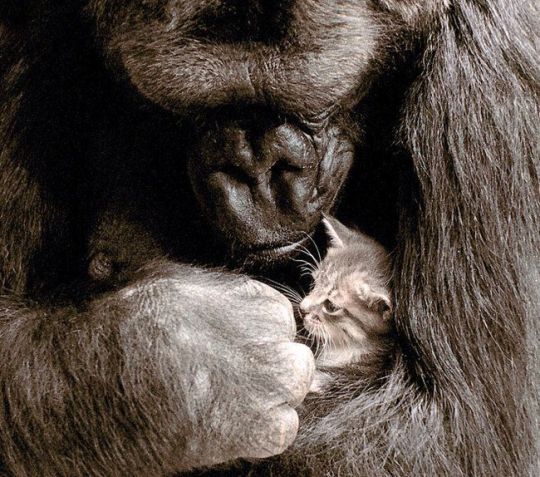
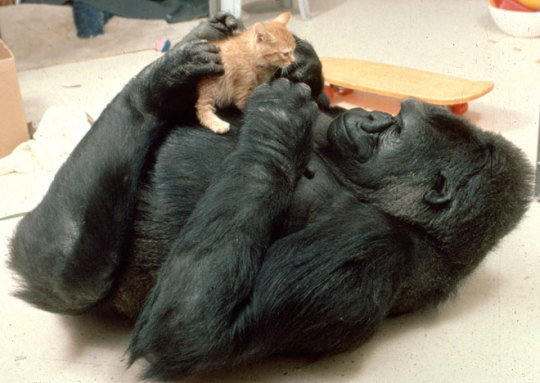
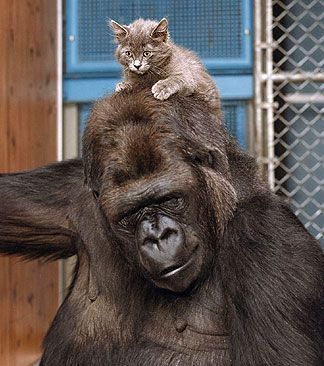
koko is a gorilla who knows a modified form of american sign language (and can understand spoken english as well) and uses it to communicate with her teacher and caregiver, francine “penny” patterson, and in 1984 she asked for a cat for her birthday! she was allowed to choose a kitten from an abandoned litter — she chose a tiny gray manx kitty and named him all ball. he was taken to see her in the evenings, and then later he would visit on his own. she treated him like the other gorillas treated their babies, and tolerated his biting without any aggression. here’s her and her beloved ball:
later all ball escaped from the zoo and got run over by a car, sadly. koko was very sad about it, but later in 1985 she got two new manx kittens, lipstick and smoky! here’s her playing with lipstick:
and here’s her with smoky!
in 2015 for her birthday, koko picked out two more kittens and named them miss black and miss grey!
koko turns 46 today! she also understands object displacement, has passed the mirror test, has relayed personal memories, can talk about language, has used language deceptively, has used false statements humorously, and has invented new signs to talk about things she doesn’t know the sign for (for example she didn’t know the sign for ring, but combined the signs for “finger” and “bracelet” to convey the same meaning)! these are all things that show a more developed degree of understanding than is usually associated with primates that aren’t humans.

Dude sounds like some choosy guy who has to use a surrogate… Must not have ultimate power if he can’t come down from his high throne and do it himself??




 Archive