Malala really is a class act for standing up against the horrors many women and girls face around the world. She needs to be protected at all costs, bc the world needs more people like her.
No but the history behind this picture is really interesting
The reason that everyone always looked miserable in old photos wasn’t that they took too long to take. Once photography became widespread it took only seconds to take a picture.
It was because getting your photo taken was treated the same as getting your portrait painted. A very serious occasion meant so thst your descendants would know that ypu existed and what you looked like.
But one time some British dudes went to china to go on an anthropological expedition, and they met some rural Chinese farmers and decided to take their pictures. Now, these people weren’t exposed to the weird culture of the time around getting your photo taken, so this guy just flashed a big grin during the photo because he was told to strike a pose and that’s the pose he wanted to strike.
I think painted portraits and old photos give us the idea that in general people were just really unhappy because those are the visuals we have. This is so refreshing.
Hey, look; “Man Laughing Alone With Rice” is back on my dash.
I’m re-watching the Prince of Egypt, and the whole God saying “totally, just kill a lamb and paint your door with it’s blood so I know not to kill your first born children” really strikes me as a ruthless Pagan God move…
So my question is… What the fuck?
Some secondary and follow up questions? are:
God sent plagues, but that feels like a lot more work than just saying “Hebrews grab your shit, revolt, and leave, you easily out number the Egyptians.”
God appeared to Moses as a burning bush… Why not something idk, more obviously god-like? He has ultimate power and chose to look like flaming shrubbery.
This story is so weird, because you could change the names of the people and places, then tell me it’s a fantasy story about some Pagan God that wants to deliver his worshippers out of bondage.
But also fuck everyone else who’s having a rough time? He doesn’t care about delivering anyone else, including future enslaved races? Just the Hebrews… That one time… Dude sounds like some choosy guy who has to use a surrogate… Must not have ultimate power if he can’t come down from his high throne and do it himself??
If someone can give me a real solid answer as to why God sounds just exactly like some Pagan Gods (with the lambs blood, water into blood, plagues and shit) then I will shut the fuck up. Until then, imma be questioning this
So these kinds of questions are always amusing from the Jewish perspective, because well…we talk about this all the time. Why bother killing the first borns? Dayenu. (It would have been enough to just let us go free.)
But basically, you’re approaching this from a heavily christian-normative atheist perspective. I don’t think asking Xtians about this story will help, because this is the most fundamentally Jewish story to be tackling.
Here goes:
“totally, just kill a lamb and paint your door with it’s blood so I know not to kill your first born children” really strikes me as a ruthless Pagan God move…
Animal sacrifice absolutely exists in the Torah and during the first and second temple periods. The fact that Judaism explicitly bans all human sacrifice is seen as (in historical context) a huge step away from pagan ritual sacrifice. Many scholars believe the shift to animal sacrifice in general is reflective of understanding man’s more primal urges, and redirecting it away from murder or human sacrifice.
At any rate, the sacrifice of the lamb and painting of the lintel with lamb’s blood could have any number of possible parallels or reasonings.
It’s worth noting that sacrificing a lamb would be considered to be inappropriate by the Egyptians, which is mentioned right there in the text of Exodus. (I assume you didn’t read it):
(Chapter 8) 21 Thereupon, Pharaoh summoned Moses and Aaron, and he said, “Go, sacrifice to your God in the land.” 22 But Moses said, “It is improper to do that, for we will sacrifice the abomination of the Egyptians to God our Lord. Will we sacrifice the deity of the Egyptians before their eyes, and they will not stone us? 23 Let us go [for] a three day journey in the desert and sacrifice to the Lord, our God, as He will say to us.” 24 Pharaoh said, “I will let you go out, and you will sacrifice to the Lord, your God, in the desert, but do not go far away; entreat [Him] on my behalf.”
The Egyptians had Sheep/Ram headed Gods, so it’s not surprising that sacrificing a lamb for God would indicate that the Jewish people are truly not Egyptians, especially if an Egyptian might be inclined to stone someone for doing this.
The choice of sacrificing a sheep might very well be completely intentional as an affront against Egyptian oppressors. We have corroboration historically about the importance of rams and sheep in Egypt:
Herodotus, in his survey of Egyptian customs, writes (Histories, 2:42):
Now all who have a temple set up to the Theban Zeus (=Amun) or who are of the district of Thebes, these, I say, all sacrifice goats and abstain from sheep… the Egyptians make the image of Zeus (=Amun) into the face of a ram… the Thebans then do not sacrifice rams but hold them sacred for this reason.
So this isn’t just a random “pagan” act, this is a group of people intentionally sacrificing an animal held sacred as representative of a pagan god, because that is what God requires and asks for. The Egyptians would never sacrifice a sheep, if the sheep represents some of their deities – but the Hebrews, who do not worship pagan gods, most certainly would.
If you read chapter 9, you will also see Pharaoh try and command that the Hebrews should leave behind their sheep and cattle (in part to prevent their sacrifice) – which they refuse to do.
The “sacrifice” of the lamb fulfills a few different purposes:
it is considered sacrilegious by the Egyptians, thus setting them apart from the pagans (and symbolically showing a willingness to destroy pagan gods)
the lamb is meant to be cooked and prepared so that the families can eat it. It’s a meal to be prepared in light of the fact that they’re preparing to flee.
Torah also tells us the blood is a sign for the Hebrews, and not the Egyptians. The blood is actually marked on the inside of the door (as per Rashi’s commentary on the Hebrew), and therefore the only people who can see the blood would be God (who is able to see all) and the Hebrews from inside their homes. It looks more impressive to do it the other way when you animate it, though.
The verse shows us this:
And the blood will be for you for a sign upon the houses where you will be, and I will see the blood and skip over you, and there will be no plague to destroy [you] when I smite the [people of the] land of Egypt.
Rashi explains: And the blood will be for you for a sign: [The blood will be] for you a sign but not a sign for others. From here, it is derived that they put the blood only on the inside. — [from Mechilta 11]
and I will see the blood: [In fact,] everything is revealed to Him. [Why then does the Torah mention that God will see the blood?] Rather, the Holy One, blessed be He, said, “I will focus My attention to see that you are engaged in My commandments, and I will skip over you.” -[from Mechilta]
Your other questions are also interesting:
God sent plagues, but that feels like a lot more work than just saying “Hebrews grab your shit, revolt, and leave, you easily out number the Egyptians.”
Well, again, have you read a haggadah? We uh, talk about this once a year. If God had let us flee Egypt and not bothered with punishing our oppressors – that would have been enough!
So like, in general, you can’t attend a passover seder without questioning…why God bothered with the plagues.
God appeared to Moses as a burning bush… Why not something idk, more obviously god-like? He has ultimate power and chose to look like flaming shrubbery.
A bush that is on fire but does not get burnt is pretty impressive. But again, I guess you haven’t actually read exodus, because it’s not just a burning bush:
An angel of the Lord appeared to him in a flame of fire from within the thorn bush, and behold, the thorn bush was burning with fire, but the thorn bush was not being consumed.
So Moses said, “Let me turn now and see this great spectacle why does the thorn bush not burn up?”
An angel appears in the fire, the thorn bush is on fire, but does not burn. Then God appears. But eh, maybe that isn’t as wild as you want it to be, so the following exchange between Moses and God is a bit more…miraculous. First God turns Moses’ staff and turns it into a serpent, and back into a staff. This is the first sign Moses can use to prove that God is here. And then…
And the Lord said further to him, “Now put your hand into your bosom,” and he put his hand into his bosom, and he took it out, and behold, his hand was leprous like snow.
And He said, “Put your hand back into your bosom,” and he put his hand back into his bosom, and [when] he took it out of his bosom, it had become again like [the rest of] his flesh.
…you might want to picture it a little bit like this:
– You best start believing in holy stories, Moshe. – you’re in one.
But again, you don’t need to believe in this literally or accept it as literal. But I think it’s a bit silly to say it’s not “miraculous” enough or something.
This story is so weird, because you could change the names of the people and places, then tell me it’s a fantasy story about some Pagan God that wants to deliver his worshippers out of bondage.
Except you couldn’t, which is why it’s a story about the Jewish monotheistic God. If you swapped out the name of God and the people, it would still be a monotheistic story.
You could take “In order that they believe that the Lord, the God of their forefathers, has appeared to you, the God of Abraham, the God of Isaac, and the God of Jacob.“
and instead say “the King, the Ancient One of their forefathers, has appeared to you, the God of Maharba, the God of Caasi, and the God of Bocaj,” but you’re still fundamentally naming a monotheistic deity.
But also fuck everyone else who’s having a rough time? He doesn’t care about delivering anyone else,
Again, this isn’t true, and even PoE illustrates this! Watch it again, and you’ll notice Egyptians dropping their weapons and walking alongside the Hebrews, even crossing the sea! and why else would God give commandments before the Hebrews cross the sea about what to do with the converts and strangers living among them?
Exodus 12:37-38:
The children of Israel journeyed from Rameses to Succoth, about six hundred thousand on foot, the men, besides the young children. And also, a great mixed multitude went up with them, and flocks and cattle, very much livestock.
These are the others, fleeing with the Hebrews. Anyone who wanted to flee was able to do so, and join the Israelites.
including future enslaved races? Just the Hebrews… That one time…
Well there’s a few ways to look at this. But I don’t believe this is an issue of “just this one time.”
1.) the issue of the Jewish people being enslaved and kept from Israel is an issue because if the Jewish people fulfill their end of the covenant (contract) then God should also fulfill their promises. An exodus from slavery in Egypt had to occur for the return to Israel to happen. The covenant is a contract. God is making good on their end of that contract with the exodus.
So here, God intervenes lest they fail to uphold a contract.
2.) But also, ultimately, Judaism promotes the idea that in times of distress mankind should act as if there is no God, and do the right thing. We take action because it is up to us to take that action. It was ultimately up to the Israelites to leave Egypt, even if God made it seem more possible to do so. It was up to the Israelites to pack their things and prepare their rations and even up to them to bravely step forwards into the sea and keep going, even though it took time for the waters to part. (Some say the waters did not part until the Israelites were so far into the water that it would have drowned them.)
So have other people been liberated from slavery? Absolutely. You have two choices – you can say it was because of “God” or you can say it was because of the hard work of abolitionists and slave uprisings. It’s not a mystery why the African American community references Exodus so heavily in gospel music – Jewish freedom is a template for all freedom (and anyways, there are also black Jews!). So did God free black slaves, or did black men and women and abolitionist allies work tirelessly for that freedom? Couldn’t it be both? Shouldn’t we say, be capable of going “If God freed us then, then now our lives should be also dedicated to freeing everyone else?” Why would you assume mankind is free from the work of liberation? It is our job to work for freedom on behalf of others, not to just sit on our ass and expect God to do the work.
Again, no surprise that Jewish Americans were involved in abolitionism throughout the world and heavily involved in the US civil rights movements.
Dude sounds like some choosy guy who has to use a surrogate… Must not have ultimate power if he can’t come down from his high throne and do it himself??
…Choosy, absolutely. Not having ultimate power is endlessly debatable. One way or another, it happened, and certainly God sent down the forces to do so in Exodus. But also, uh, you realize a lot of this was a learning and teaching process, right?
If someone can give me a real solid answer as to why God sounds just exactly like some Pagan Gods (with the lambs blood, water into blood, plagues and shit) then I will shut the fuck up. Until then, imma be questioning this
Like I said, lamb’s blood is in direct contrast/opposition to local Pagan worship.
The Nile running red with blood is actually deeply symbolic – recall that in the beginning of the Exodus story, the first born Hebrew sons are being thrown into the Nile River. So what God is doing is illustrating the fact that the Nile was filled with the blood of the Hebrew people – specifically their firstborn sons – and this is the blood which Pharaoh was responsible for shedding. It’s similar to Macbeth, when Lady Macbeth hallucinates blood on her hands after her murderous act. Except here, the entire Nile turns to blood, haunting Pharaoh with the blood of the slaves his father had murdered. Talk about facing the reality of your actions. This is where the blood comes from.
Either way, none of these things make God more or less pagan? The issue of paganism is not how a God acts or behaves, but whether or not there are other Gods. Like that’s literally it. Hope that helped? Lmao. These questions aren’t that weird.
Shoot son, you sure rose to that challenge!
Ngl, you schooled me. Historical context was missing in the movie, so you’ll have to give me that one. The rest of that I never fucking learned in years of Sunday school, (and these kind of questions weren’t encouraged.) Thank you, @keshetchai I’ve learned a lot today!
Forgive me that I remain skeptical, it still boils down to having faith or not having faith; this isn’t a reflection of you though and thank you again for such a thorough answer 🙂
no problem! This is a big example of the massive differences between Judaism and xtianity as a whole. A lot of the questions you touched upon are built in to the passover seder, and are encouraged. We ask exactly a lot of these things!
There’s also a part of the seder where we discuss the four questions (why is this night different from all other nights?) and then we discuss the Four Children, each child covering a different attitude towards the story. To paraphrase:
The Wise Child asks: What does this all mean? What are the laws we are commanded, the customs and traditions we uphold?
The Wicked Child*** asks: What does this mean to you? [Why do you even bother with all this?] ***wicked isn’t like, “evil” it’s more like “challenging.” or “isolated” from the community by distancing themselves.
The Simple Child asks: What is it that we’re doing? What’s the seder about?
The Child Who Does Not Know How to Ask doesn’t ask a question at all, and instead can be prompted into thinking of questions to ask, being helped to understand things, or may just be too young to formulate the question– and yet we still must include them.
Each “type” of question is meant to be met with an answer. So asking these questions might be discouraged in xtianity, but is part of the Jewish tradition.
It’s okay if you don’t believe everything, or don’t take it literally. Honestly, that isn’t why I answered your questions – I’m not concerned about convincing you of the truth or literalism of the story. I just think it’s fair to want honest answers to interesting questions. Personally, whether or not it happened literally isn’t really a big deal for me, or even where i derive meaning when hearing the story. Faith means something different in Judaism than it does in xtianity, so I don’t have any kind of investment in trying to convince you to “just believe” because someone said so.
if you don’t want to believe in parts or all of it, it’s no skin off my nose. Frankly, I’m way more concerned with impressing the idea that “slavery is bad and we as people are obligated to help in the liberation of others.” 🙂 the times when these questions become an issue are when gentiles present the questions as if Jewish people are stupid/backwards/barbaric/etc. That would be an issue, but asking “what the hell was going on there??” earnestly isn’t.
Reblogging because:
(a) this is an excellent and thoughtful discussion of various theological issues;
(b) I really appreciate people doing what @keshetchai does here, giving questions serious, thorough, and kind answers;
(d) this is just a super sweet exchange all round; and
(e) I learned things from it! (I did not realize about the blood being on the inside of the doors, or about other Egyptians joining the Israelites in their flight.)
(koko’s full name was actually hanabiko, which means “fireworks child”, which is a reference to her birthday: the fourth of july!)
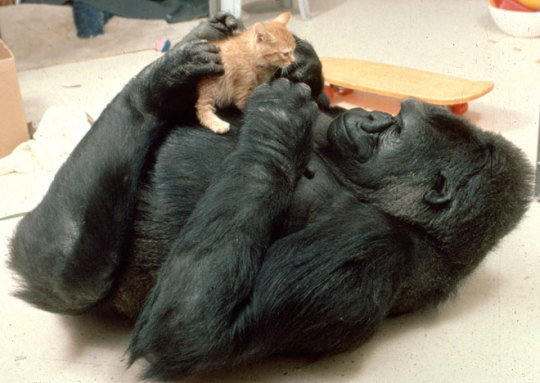
koko is a gorilla who knows a modified form of american sign language (and can understand spoken english as well) and uses it to communicate with her teacher and caregiver, francine “penny” patterson, and in 1984 she asked for a cat for her birthday! she was allowed to choose a kitten from an abandoned litter — she chose a tiny gray manx kitty and named him all ball. he was taken to see her in the evenings, and then later he would visit on his own. she treated him like the other gorillas treated their babies, and tolerated his biting without any aggression. here’s her and her beloved ball:
later all ball escaped from the zoo and got run over by a car, sadly. koko was very sad about it, but later in 1985 she got two new manx kittens, lipstick and smoky! here’s her playing with lipstick:
and here’s her with smoky!
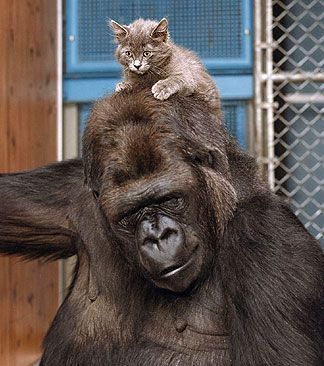
in 2015 for her birthday, koko picked out two more kittens and named them miss black and miss grey!
koko turns 46 today! she also understands object displacement, has passed the mirror test, has relayed personal memories, can talk about language, has used language deceptively, has used false statements humorously, and has invented new signs to talk about things she doesn’t know the sign for (for example she didn’t know the sign for ring, but combined the signs for “finger” and “bracelet” to convey the same meaning)! these are all things that show a more developed degree of understanding than is usually associated with primates that aren’t humans.
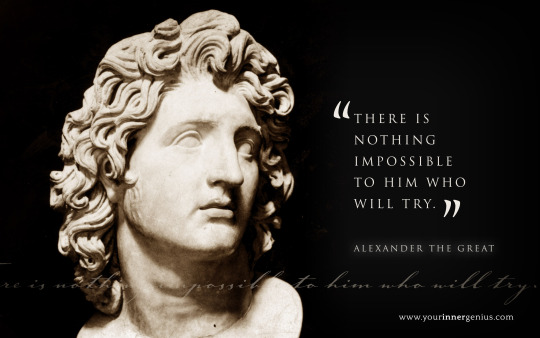
one time alexander the great rode dick for 8 hours and then spent 8 hours the next day riding a horse, and that’s why i believe bottoms deserve more credit
Except no, he didn’t. There is no evidence anywhere that says Alexander the Great was gay. What historical reference says that? His multiple wives maybe? His many children born to them? Or whatever delusion you’ve cooked up to pass your own opinion?
honey , i’m not spending an extra year in uni to get a classics degree not to respond to this directly
i) alexander had one (1) unborn child at the time of his death, because he only, miserably, managed to knock up one of his three (3) wives after his boyfriend died
–> had alexander produced more than ONE (1) child, the hellenistic age would not have been defined by the fallout caused by his generals warring to decide a successor, ultimately destroying his empire and arguably sending everyone from macedon to modern-day palestine into a cultural dark age
ii) macedonian kings took multiple wives to secure succession, a political move that alexander resisted despite the urging of both antipater and olympias (i’ll let you google them on your own time) for almost an literal
decade
– > there’s an anecdote found in the curtius , your “historical reference” – you can google his dates – about alexander’s parents sending him a hooker because they were afraid he didn’t … how do i say it nicely? wanna fuck women
it’s absolutely true that you can’t say alexander was gay; that’s grossly reductive, because sexuality didn’t exist by modern definition in ancient times. more, alexander DID bone a woman, willingly, at one point – a satrap’s (google that) wife, named barsine, with whom he may or may not have produced a bastard child called heracles. getting dicked down doesn’t negate wanting to dick another down, an interesting concept that you would be familiar with if you took a quick jaunt out of that homophobic bubble wrap you’ve duct-taped yourself into. we also can’t FOR SURE 100% conclusively say that alexander and hephaestion boned; but plutarch, curtius, and diodorus are some notable biographers who delve into detail about alexander’s life-long, likely romantic connection to his right hand man, who he mourned so excessively at the time of his death that there was hardly a dime left for alexander’s own funeral. they didn’t make that shit up – you can google what source criticism is, but some of THEIR sources included ptolemy i soter and callisthenes – oof, more people for you to google! modern scholars from reames to borza to müller to green assume that he was getting dicked down for the above reasons, too!
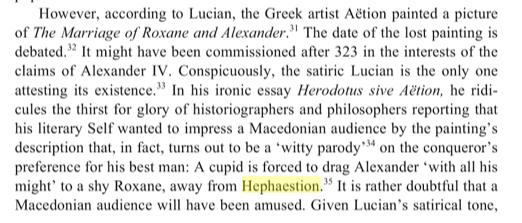
at last, i shall acknowledge that my Humour Post refers to lucian (pro lapsu inter salutandum 8), who has some wink-wink-nudge-nudge content concerning who slept in whose tent when, but who wants to retread old ground? here’s another one of my favorites instead:
323 was the year of alexander’s death (historical!), but even if lucian made all of this up, as this scholar seems to nudge at, it’s still quite telling that a cultural memory and historical tradition that the romans associated with alexander included his love of massive, throbbing cocks, non?
people who share your dreadfully uninformed and outdated opinion include, if i’m not mistaken, a handful of stodgy greek lawyers, a man named william woodthorpe tarn, and helmut berve. tarn was an imperialist, and berve? a literal nazi.
I’m sorry but I just had to reblog this. This is a fucking epic beatdown.
2 dudes, chillin in open graves, 5 feet apart cause they’re not gay
This is actually an art piece by Miller & Shellabarger where they dug graves connected by a tunnel so they could hold hands. They are very much gay and irl married
The EPIC OF GILGAMESH is the earliest great work of literature that we know of, and was first written down by the Sumerians around 2100 B.C.
Ancient Sumer was the land that lay between the two rivers, the Tigris and Euphrates, in Mesopotamia. The language that the Sumerians spoke was unrelated to the Semitic languages of their neighbors the Akkadians and Babylonians, and it was written in a syllabary (a kind of alphabet) called “cuneiform”. By 2000 B.C., the language of Sumer had almost completely died out and was used only by scholars (like Latin is today). No one knows how it was pronounced because it has not been heard in 4000 years.
What you hear in this video are a few of the opening lines of part of the epic poem, accompanied only by a long-neck, three-string, Sumerian lute known as a “ngish-gu-di”. The instrument is tuned to G – G – D, and although it is similar to other long neck lutes still in use today (the tar, the setar, the saz, etc.) the modern instruments are low tension and strung with fine steel wire. The ancient long neck lutes (such as the Egyptian “nefer”) were strung with gut and behaved slightly differently. The short-neck lute known as the “oud” is strung with gut/nylon, and its sound has much in common with the ancient long-neck lute although the oud is not a fretted instrument and its strings are much shorter (about 25 inches or 63 cm) as compared to 32 inches (82 cm) on a long-neck instrument.
For anyone interested in these lutes, I highly recommend THE ARCHAEOMUSICOLOGY OF THE ANCIENT NEAR EAST by Professor Richard Dumbrill.
The location for this performance is the courtyard of Nebuchadnezzar’s palace in Babylon. The piece is four minutes long and is intended only as a taste of what the music of ancient Sumer might have sounded like.

Dude sounds like some choosy guy who has to use a surrogate… Must not have ultimate power if he can’t come down from his high throne and do it himself??




 Archive