why do anime girls from the 80s and 90s look so much better than anime girls today
Three factors: Color, personality, and realism.
First, color and shading.
vs.
The predominant style of the day in anime employs very crisp cell shading and eye-watering colors. Both female and male hair and eye coloration comes in any range of colors, from neon to pastel to white (although female characters most often display this). The typical color for skin in anime has gradually lightened to almost pure white over the years. Additionally, modern anime has a very specific, hard method of shading and highlighting that makes hair and skin look unnaturally shiny and often gross, lowering the realism value and throwing the texture of the skin into uncanny valley territory.
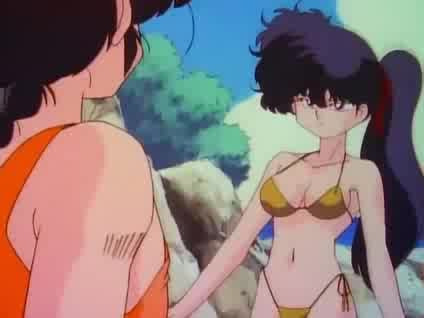
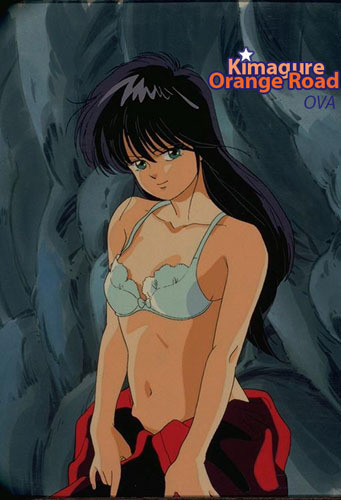
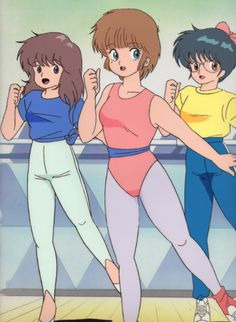
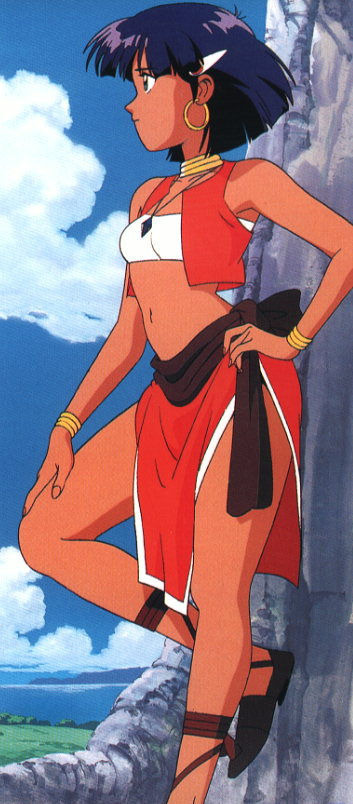
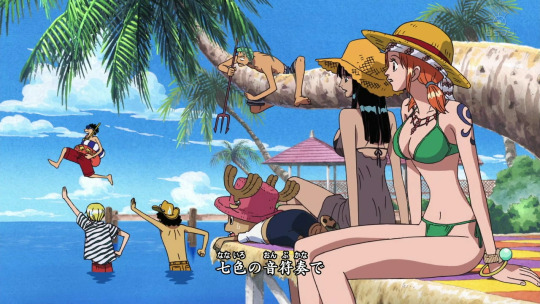
Secondly, anatomical proportions. Besides the shading, female character body and facial proportions have degraded so much that they are barely caricatures of human anatomy. Here are some examples of female anatomy in early anime:
and some in modern anime:
The biggest changes have been to the breast to waist proportion. For some reason, anime producers believe that an E-cup is the appropriate cup-size for an average 14 year old Japanese female. Bodies have also lost all of their depth (that come from an illusion of thickness necessary to two dimensional media) in favor of being skinny and flat (except for voluminous breasts, of course) and many normal, attractive parts of ladies (ribcages, stomach pooches, and natural folds) are simply smoothed over. Another noticeable change has been to the eyes and facial shape. Anime noses and mouths are apparently inversely proportional to eye shape, size, and distance apart. As the size of the eye increases, shape becomes more prominent, and distance towards the ears increases, the size of the nose, mouth, and chin decrease, contributing highly to the uncanny valley effect many modern any girls have.
Take these faces:
vs these
Thirdly, anime girls have lost much of their visible personality over the years due to moefication. This has happened to male characters also, although to a lesser extent. Anime girls are often not allowed to make cartoonish expressions (deemed unattractive) or generally change their expressions at all barring blush lines. In producers’ efforts to make the girls attractive to the audience in every frame, they sacrifice any personality that they might have. Anime girls look increasingly similar to one another, differentiated only by their hair style and eyes. Granted, there has always been a problem with female character same-face syndrome since the conception of anime (actually, in all drawn media) but as the number of female main characters in anime has grown, ironically, the problem has only increased.
Wow! Anime girls with the same hair color that you can actually tell apart!
And somehow, girls with all different colors that you can’t.
TLDR: modern anime girls look like washed out bobbleheads with no personality in a sad attempt to piggyback off of the success of older anime with more fleshed out (literally and figuratively) female characters
The screenshots in this post were taken from Urusei Yatsura, Neon Genesis Evangelion, Nadia: The Secret of Blue Water, Ranma ½, Kimagure Orange Road, Ping Pong Club, One Piece, Angel Beats, Higurashi When They Cry, Sword Art Online, Shakugan No Shana, and Chobits. The examples above were not used to bash any anime, but merely to demonstrate the evolution of anime art tropes from the 1980s to now.
Kamehameha Day was established by royal decree on December
22, 1871 by King Kamehameha V in order to honor the memory of his great
grandfather Kamehameha (Kalani Pai‘ea Wohi o Kaleikini Keali‘ikui Kamehameha
o ‘Iolani i Kaiwikapu kaui Ka Liholiho Kūnuiākea) (c.1758-1819), the chief who
had united the Hawaiian Islands and became the first king of Hawai‘i.
The first celebration of Kamehameha Day was held June 11, 1872 and continued
until a group of white businessmen and descendants of missionaries carried out the illegal overthrow of Queen Lili‘uokalani in 1893. In 1904, the
holiday was reinstated by Prince Jonah Kūhiō Kalaniana‘ole and it continues to
be celebrated on June 11 to this day.
To commemorate the day,
we are sharing images from our first edition copy of Voyagers by Herb Kawainui
Kāne
(1928-2011) depicting King Kamehameha.
Milwaukee, Wisconsin may seem a bit removed from the festivities of the day, but perhaps not as much as one would think. First, UWM Special Collections holds a considerable collection of Native American, First Nations, Inuit, and Hawaiian literature (of which Voyagers is a part). Secondly,
Kāne’s mother’s family were farmers from Wisconsin, and Kāne spent a good part of his childhood in the state. He also received his MFA not too far from here at the School of the Art Institute of Chicago/University of Chicago. He is among the first Native Hawaiian artists to achieve international repute.
Growing up, Kāne dreamed of
rebuilding a double-hulled sailing canoe similar to the ones his ancestors had
used to sail from Tahiti to Hawai‘i, but it had been over 600 years since these
canoes had last been seen. In the 1970s, Kāne founded the Polynesian Voyaging
Society where he and others combined their research and knowledge in order to make their dreams a reality. They were
successful in their efforts, ultimately building the sailing canoe Hōkūle‘a, of
which Kāne became the first captain in 1975. In 1976, with the help of Mau,
a traditional navigator from Satawal in Micronesia, Hōkūle‘a sailed to Tahiti
where they were greeted by over half of the island’s population at Pape‘ete
Harbor. Herb
Kawainui Kāne’s work was so important to the Hawaiian community that he was actually elected a Living Treasure of Hawai‘i in 1984. Kāne died on March 8, 2011, the 36th anniversary of the launch of the Hōkūle‘a. His place in history and that of King Kamehameha, however, remain forever in the memories of the Hawaiian people.
The EPIC OF GILGAMESH is the earliest great work of literature that we know of, and was first written down by the Sumerians around 2100 B.C.
Ancient Sumer was the land that lay between the two rivers, the Tigris and Euphrates, in Mesopotamia. The language that the Sumerians spoke was unrelated to the Semitic languages of their neighbors the Akkadians and Babylonians, and it was written in a syllabary (a kind of alphabet) called “cuneiform”. By 2000 B.C., the language of Sumer had almost completely died out and was used only by scholars (like Latin is today). No one knows how it was pronounced because it has not been heard in 4000 years.
What you hear in this video are a few of the opening lines of part of the epic poem, accompanied only by a long-neck, three-string, Sumerian lute known as a “ngish-gu-di”. The instrument is tuned to G – G – D, and although it is similar to other long neck lutes still in use today (the tar, the setar, the saz, etc.) the modern instruments are low tension and strung with fine steel wire. The ancient long neck lutes (such as the Egyptian “nefer”) were strung with gut and behaved slightly differently. The short-neck lute known as the “oud” is strung with gut/nylon, and its sound has much in common with the ancient long-neck lute although the oud is not a fretted instrument and its strings are much shorter (about 25 inches or 63 cm) as compared to 32 inches (82 cm) on a long-neck instrument.
For anyone interested in these lutes, I highly recommend THE ARCHAEOMUSICOLOGY OF THE ANCIENT NEAR EAST by Professor Richard Dumbrill.
The location for this performance is the courtyard of Nebuchadnezzar’s palace in Babylon. The piece is four minutes long and is intended only as a taste of what the music of ancient Sumer might have sounded like.
1- The Arrival
Fine ink and watercolor drawing heightened with gouache.
15.1 x 14.9 cm. (5.9 x 5.51 in).
2- Dancing to a piper
Unfinished ink and watercolor drawing.
Unsigned.
15.3 x 15 cm. (5.9 x 5.9 in.)
This scene was later redrawn with a rabbit playing a ‘cello surrounded by five dancing rabbits ( and two rabbits nuzzling each other by the black wall.)
3- The Departure
Fine ink and watercolor drawing.
15.2 x 15.2 cm. (5.9 x 5.9 in.)







 Archive