“I never learned my Navajo language and I was never inspired to learn it. As I got older, I realized how valuable our language is to the livelihood of our Navajo Nation. ” -Dr. Shawna L. Begay
Our Navajo or Diné language is in danger of becoming extinct. Help us create and develop the first Navajo-English educational media TV puppet show, “Diné Bí Ná’álkid Time” which means ‘The Navajo Movie Time.’ It will inspire and teach our youth basic language skills using media as a technology tool. Parents, grandparents, children and grandkids can learn to speak Navajo fluently together within their own homes.
Long-time friends and educators, Dr. Shawna L. Begay and Charmaine Jackson have teamed up to create this new TV pilot for an all-ages audience or for anyone who wants to learn the Navajo language.
With your support, it’ll be the first educational Navajo and English puppet show that will teach and preserve the Navajo language and culture through digital media.
After several years of extensive research on the Navajo Nation, Dr. Begay recently completed her PhD from the University of Nevada-Las Vegas with her doctorate thesis, ‘Developing A Navajo Media Guide: A Community Perspective.’ As project director, she quickly realized she was a pioneer on the topic.
“When I decided what topic to study I realized there existed very little research in Indigenous educational media, especially with our Navajo people,” stated Dr. Begay. “As Navajo people, we have our own learning objectives and Navajo way of knowing is completely different for Euro-Western schooling. I decided that I had to research and develop our own curriculum guide that is meant to teach Navajo through media.”
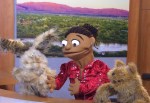
Dr. Begay and Jackson, co-writers of the show, developed the first 3-puppet characters and plan for many more. The pilot features Nanabah-a young Navajo girl, Gáh (Rabbit) and Dlǫ̀ǫ̀ (Prairie Dog) who will go on endless adventures learning about language, gardening, the environment and the importance of family values. Nanabah is fluent in Navajo and likes to teach children about life on the reservation with her animal friends and special guests. Children who want to learn Navajo will also be an important part of the show by interacting with Nanabah, her friends and storyline.
Dr. Begay’s research concluded there exists very little research in the area of Indigenous educational media. Currently media is a very powerful tool that can be used to teach. She is cognizant of the digital age we live in and the opportunities to utilize media to revitalize the Navajo language.
“Star Wars and Finding Nemo,” dubbed in Navajo, was a great place to start and it has garnered national exposure of our language. However, we need a show based on our own Navajo learning principals our ancestors set out for us to learn and live by. I don’t think a non-Navajo, non-Native or non-Indigenous person can do that for us, nor should they. We, as Navajo, need to produce this show ourselves, if we are to be truly sovereign,” added Dr. Begay.
Both educators, Dr. Begay and Jackson, of Naalkid Productions have been talking about this educational language project for about the past four years and still have a long way to go to finance their dream.
“With the support of Navajo TV Anchor Colton Shone, our team of Navajo artists, filmmakers, family and friends, this video pilot is a huge step forward,” said Jackson. “Our journey has just begun and the big next step is finding financial support to create a whole new puppet TV series.”
We aim to raise $50,000 with this project which will allow us to continue with pre-production and production aspects of making this digital media project become a reality. We need your help to save our language by teaching Navajo to our future generations.
Pre-Production: -Script writing for the pilot show -Puppet Development/Creation -Casting for puppeteers and other talent that will be on screen -Hiring of all key cast and crew
Production: -Locations and permits -Rental of Studio space -Equipment: cameras, sound, lights, etc. -Cast and Crew budget
Despite all the notes on this post, they’re still at $13,155 of their $50,000 goal.
I love animals that are, like, the opposite of cryptids: we know for a fact they exist and have a clear idea of what they look like because we have photographs and individual specimens, but we haven’t the faintest idea where they’re coming from – they just keep showing up out of nowhere, and the locations of their actual population centres are a complete mystery.
I so want examples. anyone who knows of any should post them in notes
You know, like giant squid and such. We know the bastards exist, we have credible first-hand accounts stretching back thousands of years and dead specimens washed up on shore and such, but in centuries of searching we’ve managed exactly one well-documented encounter with a giant squid in its natural habitat. We have no idea what their native range is or what their life-cycle looks like, let alone how many of them are out there.
Are there any reverse-cryptids that /aren’t/ at the bottom of the ocean?
The red-crested tree rat, for one. There have been only three well-documented encounters since 1898, and they just plain disappeared from the zoological record for over a century. The only reason we know they’re not extinct is that one walked right up to a couple of wildlife research interns at a Columbian nature reserve back in 2011, evidently out of pure curiosity, and allowed itself to be photographed and observed for several minutes before disappearing again.











 Archive